DIY: Hybrid Sweater

After seeing this post on one of my new favorite blogs, A Pair and a Spare, I decided to make my own sweater by combining two that had coordinating colors.  I loved the combination of striped and chunky cable-knit sleeves!

source: JakandJil

I wore my finished creation for Day 23 in my 30 Days of Outfits Challenge last month.  So here’s how to make your own:

Difficulty:(Medium)

You Need:

*2 sweaters in coordinating colors (I think one of mine is men’s – it honestly doesn’t matter as long as you can fit into both)
*thread matching sweaters

And…
*seam ripper
*pins
*sewing machine ( if you do not have a sewing machine, this can also be sewn by hand, though it will take a little longer)
*machine needle (for knits or wovens; it doesn’t matter)

How-To:

1. Separate the sleeves from each sweater.  You need to find the thread that binds the sleeve to the armscye, and cut it with the seam ripper, opening up the seam a little.

Then, working from the center of the seam, try to pull the thread from in-between the sleeve and the armscye.  If you get it just at the right area where the thread end is in-between the two (it’s a little tricky), you can pull the thread and the whole seam will come apart – zzzzzpth!! (*that’s my sleeve-coming-apart sound effect*).  It’s a lot easier than going all the way around the seam on the outside, picking and ripping each stitch as you go.


2. Pin the sleeves from one sweater to the armscyes of the other sweater, matching the side seams, and easing any fullness (sweaters are stretchy, so easing is…well, easy!).  Pin from the inside, with sleeve inside the body of the sweater, right sides together.

3. Stitch on your machine around the armscyes, using a shorter stitch.  If you like, going over the edges again with a zigzag stitch or overcast stitch will add extra strength.

If you’ve sewn close to the edges, the new seam will be virtually indistinguishable from the outside.

4. Wear and enjoy!  Don’t forget to dry flat whenever you wash your piece – you don’t want undue stress on the arm seams ripping your new arms off!  (although that visual makes me a little squeamish…;-)

Happy DIY’ing!

xoxox
Carly

~If you liked this post, please share it!~
Leave Comment

DIY in 5: Faux Fur-Lined Hood

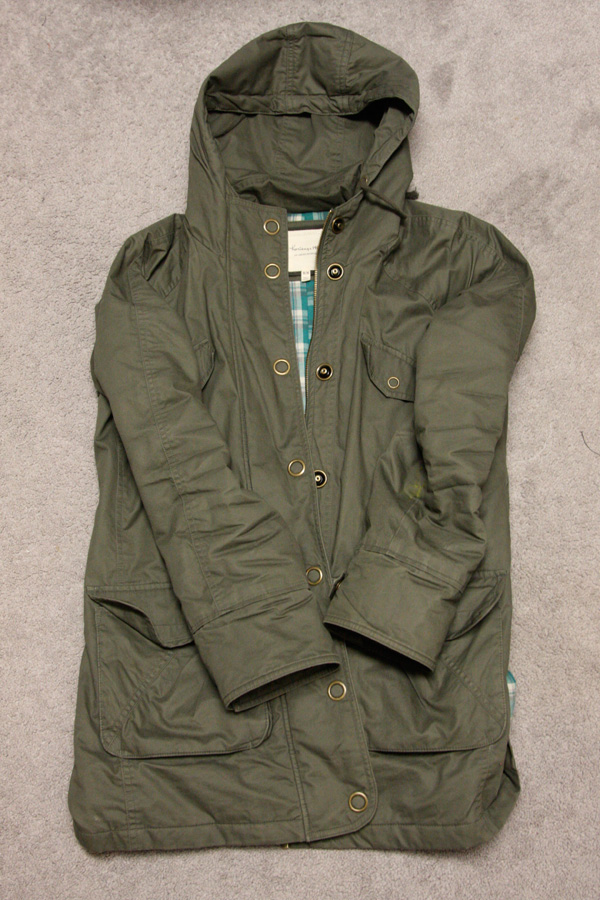
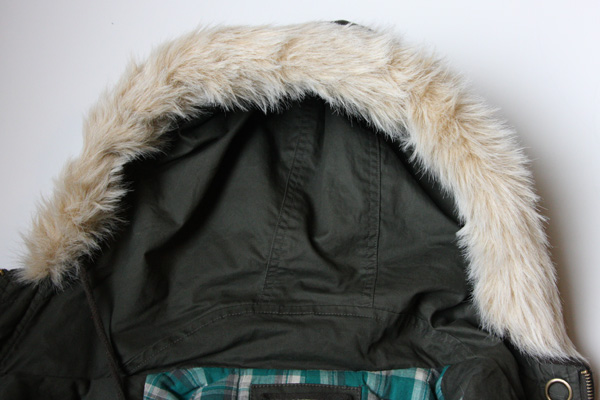
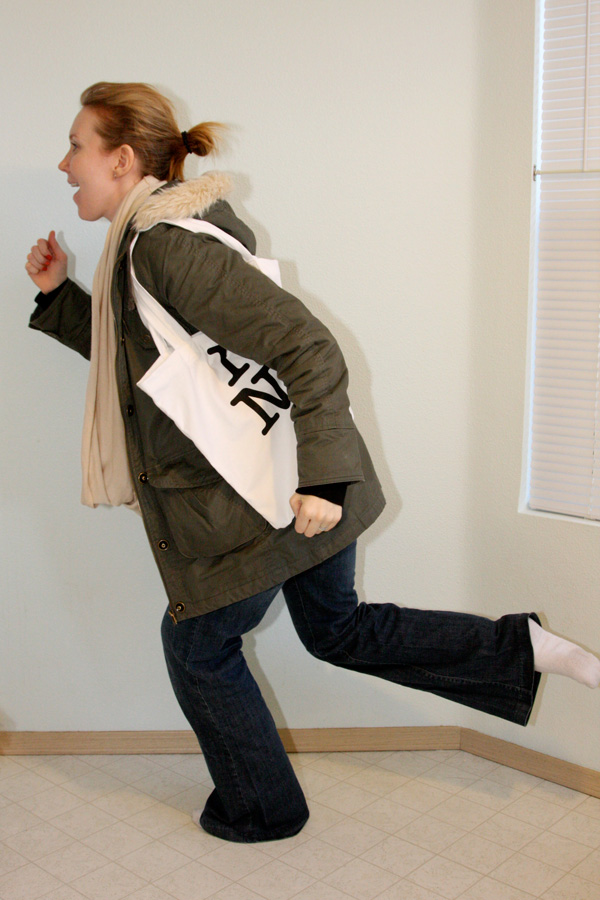
Earlier this month I wore it in an outfit, today I’m going to show you how to DIY it.  It’s DIY in 5minutes, that is.  The easiest, quickest ways to take a piece from blah to fab and update it to current trends.

Fur trim is applicable for anything hooded: a sweater, hoodie, or jacket. (Or even on pocket edges, lapels, flaps…you get the idea!;-)   As the temperatures drop, the need to bundle up increases – and adding a layer of furry material adds a ton of warmth.  I always shop cheap when I can – but often affordable prices mean skimpy manufacturing techniques and minimal trim and details.  Add more value to your bargain pieces by adding a quick-and-easy line of faux fur trim to your favorites.

You Need:

*hooded piece to embellish
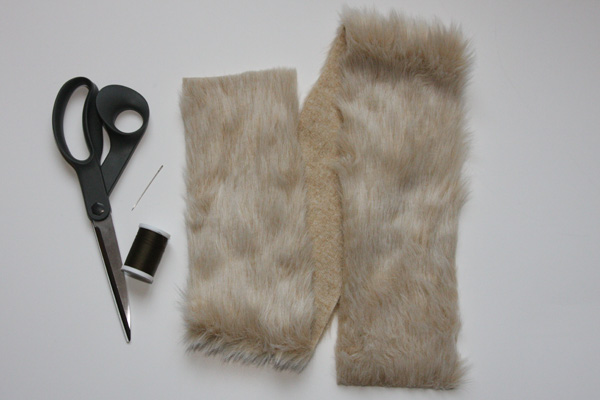
*faux fur trim long enough to go around the hood – mine was 5″ wide (or a strip cut from faux fur by the yard)

And…

*scissors
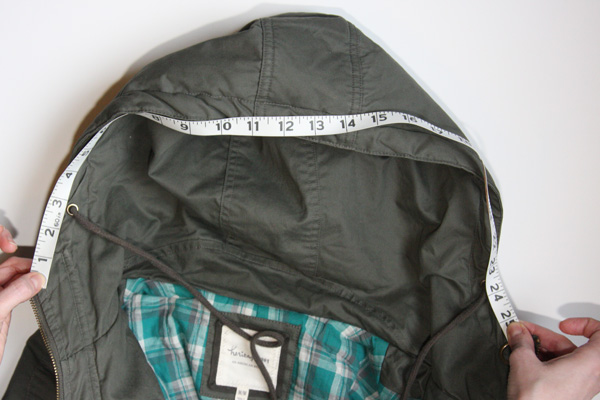
*measuring tape
*sewing machine and thread matching fur
*hand-sewing needle and thread matching your hooded piece
*skewer, knitting needle, or chopstick

How-To:

1. Measure around your hood to find out how long your trim needs to be.  (Add about 3/4″ to each end so you have enough trim for the seam allowance.)  Cut trim according to measurement.

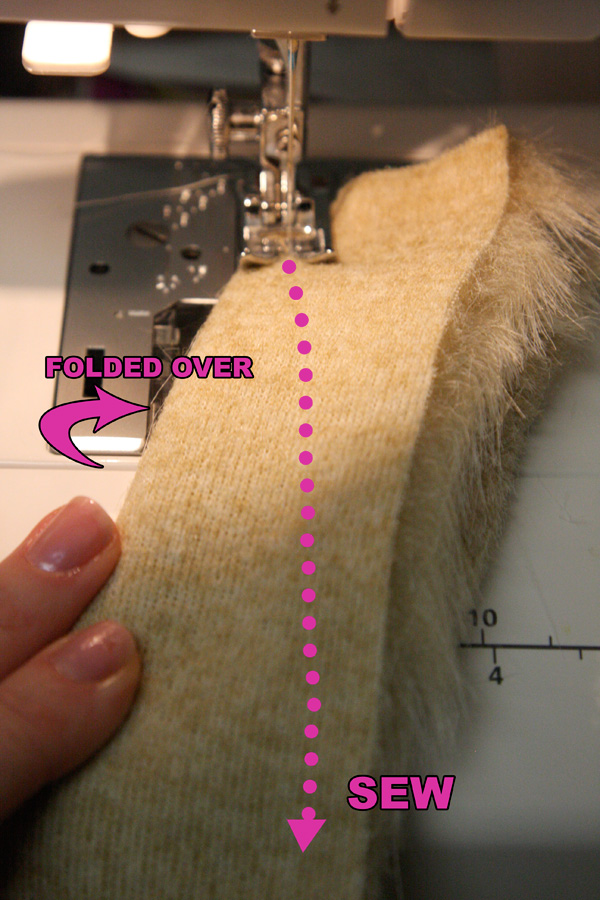
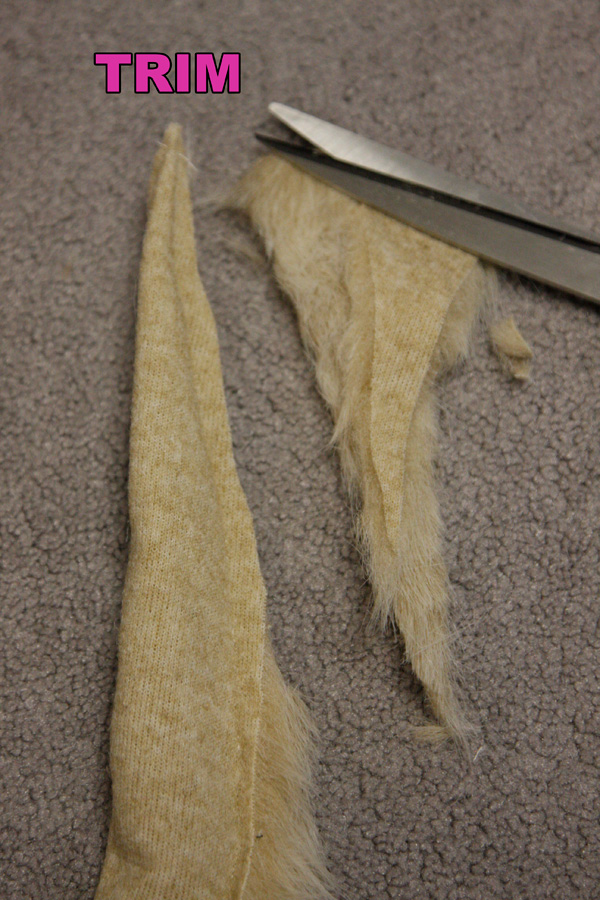
2. Fold the trim over on itself lengthwise and sew into a tube on your sewing machine, leaving about 2″ unsewn in the center of the seam.  Taper the ends.

3. Trim the excess at the ends.

4. Turn right-side-out using a skewer, knitting needle, or chopstick.

5. Use the skewer to pull any fur our of the seam if it was caught in there while sewing.

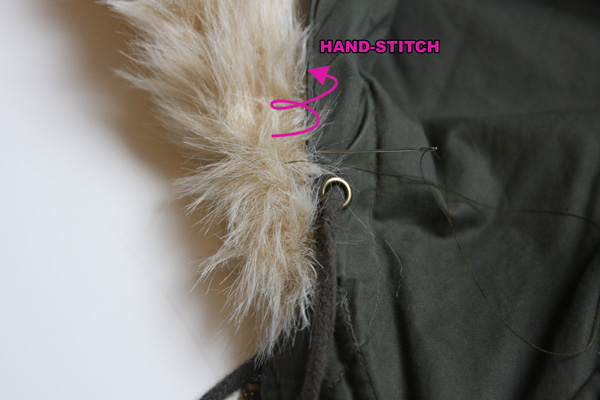
6. Use a hand-sewing needle to stitch the trim around the edge of the hood, stitching the opening in the trim tube closed as you go.

This is a super-easy way to add some wintery furriness to your favorite jacket or hoodie – and even if it takes more than 5 minutes to complete – it will most certainly take no longer than 15!

Happy DIY’ing!

xoxox
Carly

~If you liked this post, please share it!~
Leave Comment

30 Days of Outfits Challenge: Day 17

Scottie-print scarf: DIY.  Chiffon ruffle blouse: Victoria’s Secret.  Denim bustier: Forever 21.  Assorted pins: vintage; from Japan; Lamb Tac Pin: Girlprops.com; kilt pin handmade by me.  Pebble-print silk skirt: Banana Republic.  Dainty Lace Ankle Socks: SockTheory.com.  Striped espadrille wedges: Old Navy.

Day 17 in my 30 Days of Outfits Challenge: November 17.

Can you tell what runway show I was inspired by?

photos by Marcio Madeira, Style.com

Yup!  Miu Miu S/S 2010.  It was such an amazing collection with so many fabulous pieces…you could really take each look apart, bit by bit, and find yourself with so many versatile and chic accessories, jewelry items, and unique clothing.

I felt somewhat springy today (even though the weather was anything but)…and so wanted to try mixing patterns and colors and just going crazy with my outfit.

Can you guess what I made my scarf from?

…A pair of little girl’s pajama pants!!!

Yes, I found the pants at the Goodwill Outlet in Spring.  The print reminded me of the Miu Miu collection, they felt satiny, and were still in great condition.

So I washed them and then did the following:

1. Separate the legs into two separate pieces by cutting all the seams apart.

2. Sew the legs together at the waist, so you have one long piece.  Cut the ends on an angle so they look more “scarf”-like.

3. With right sides together, stitch around the edges, leaving about 2″ free.

4. Turn right-side-out and press.

5. Stitch remaining hole closed.

Very, very simple! I had been searching in fabric stores for a silky print similar to the ones in the Miu Miu show, but the fabric stores here aren’t progressive to carry anything similar.  Silky pajamas have a number of great, fun prints – that are definitely very Miu-Miu-esque and look fabulous as an accent piece!

I bought this blouse something like 15 years ago and have not worn it once.  Not once! The tag is still on it, I’m ashamed to say.  Well, now I’ve worn it!;-)

A great way to jazz up a top is to pin on a variety of brooches and pins.  I chose to do so smack-dab in the middle, which is a bit unusual, but (I think) it works.  I made the bottom brooch from a kilt pin and bits of rhinestone jewelry, beads, and findings I had lying around.

And espadrille wedges are so not confined to summer!  You can certainly wear them all year round (though you may have to switch up your leg-coverings;-)


What do you think?  Is anyone going to try embellishing with brooches differently…or start searching for that perfect pair of pajama pants to repurpose into a scarf?;-)

Oh, and Katarina from She sells sea shells has posted more of her outfits in this Challenge.  Have you checked out her blog yet?  Please visit and say hi!

xoxox
Carly

~If you liked this post, please share it!~
Leave Comment

DIY Ruffle Studded Necklace: Create Couture Challenge

Inspired by Candace Ang‘s ruffle necklaces, I created a super-simple, super-affordable version for one of my submissions for Style Sample Magazine and New York Design Shop’s Create Couture Challenge back in early August.

You Need:

*Cream Sweater Style Stretch Trim
*Large Silver Pyramid Studs


Additional Tools/Materials:

 *silver necklace or chain
*sewing machine
*hand-sewing needle
*matching thread
*pliers
*chain-cutting pliers

How to:

1. Cut the Stretch Trim in half.

2. Zigzag stitch the two halves together along the long sides on the sewing machine.  (Slightly overlapping them is best.)

3. Securely knot a long piece of thread on your needle, and make long, basting stitches along the long side of the trim piece you just made.

4. Pull thread tight to gather the trim – and knot securely on the other side.
5. Sew back through the top gathers to secure.

6. Stud the trim and fold the stud prongs down on the underside.

7. Cut chain necklace in half, and stitch both ends of it to the top ends of your ruffle piece.

 Fuzzy and fun – this was sooooo quick to do.

Totally tactile, this fuzzy trim makes an edgy statement with all that metal peeking out!

xoxox
Carly

~If you liked this post, please share it!~
Leave Comment

How To Re-Fit a Button-Down Shirt…To Your Size! Fitting 101

Get This Tutorial As a PDF

7 DIY Men's Shirt Makeovers ebook

This tutorial has been updated, and is now available as a full step-by-step with photos in my new book 7 DIY Men’s Shirt Makeovers, part of the DIY Men’s Shirt Makeovers System.

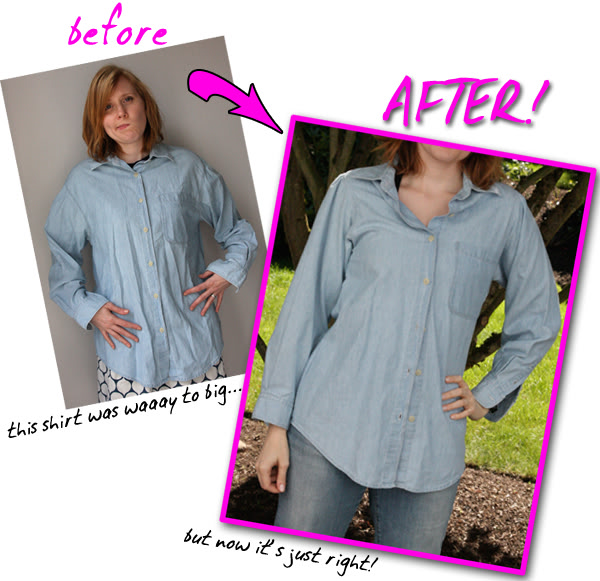
How to Fit a Button-Down Shirt before and after

Tying in to my first Style It Chic! post from yesterday regarding the denim work shirt as current closet staple, in this post I’m going to show you how to fix that denim shirt you stole from your guy – or thrifted – into something that fits you properly.

As many of you know, I love finding both my materials and base items for my DIYs at the thrift store.  I’m always searching out the biggest, baggiest shirts (so I have tons of material to work with!) for my shirt re-cons.  Thus what I find is rarely pretty, and rarely fits.  It’s always the potential for a remake that gets me so excited.

So what to do with those shirts that you find – that you want to wear yourself – but aren’t quite your size??  You’re going to be keeping the sleeves and the length, let’s say, but why doesn’t the shirt look like it fits right?  And what to do? 

Can you tell what it is that’s making my shirt look too big in the above photo?
This brings me to my first Fitting Tip, the most critical for making your shirt look like it’s the right size:

Fitting Tip #1: The make-it-or-break-it “does it fit?” criteria is where the ARMSCYE SEAM HITS THE SHOULDER SEAM.
shirt refit,alteration,sewing,fitting

I cannot stress this one enough.  This is what makes the difference visually between “she’s wearing her boyfriend’s shirt” and “she’s wearing a cute shirt that fits her.”

We’ve all tried on a guy’s shirt before, right?  And, invariably the seam connecting the sleeve to the shirt (called the “armscye seam”) will be hanging off our shoulders, lying somewhere on our upper arms.

This is a DEAD GIVEAWAY that your shirt doesn’t fit you!!

Even if the body is un-fitted, loose-fit, billowy tunic, whatever…if this seam is in the wrong place on your body then it will look like it is the WRONG SIZE FOR YOU!

When looking at yourself standing normally, this seam needs to be as close as possible to traveling straight up from your armpit to your shoulder, in a straight line.  (Raglan or set-in sleeves are different, and there is a little variation to be had when you’re dealing with a blouson, caftan, or loose blouse or dress but in general this seam needs to be in that basic area.)

The closer this seam is to going straight up from your armpit – the more fitted and chic the garment will look.  Even a t-shirt will look flattering and feminine if the sleeves are attached to the body at this line.

Fitting Tip #2: The body needs to connect close to your underarm for the garment to look “fitted.”

The body is far less important than this armscye seam in Fitting Tip #1.  There are more variations when it comes to the shape and size of the body piece, so words like always or never aren’t very useful here.  Again, in general if the body is too loose right at the underarms, the piece will look big and billowy on you, even if the armscye seams are in the right place.

So how to re-fit your shirt?

How to Re-Fit a Men’s Button-Down Shirt To Your Size


You Need:
seam ripper  //  marking chalk  //  pins  //  scissors  //  sewing machine & needle for the fabric in your shirt  //  thread matching the topstitching thread in your shirt  //  mirror

The Straight Pin Method: How to Move the Shoulder Seam of a Too-Big Shirt to Fit Your Body

1. Remove both sleeves by opening the armscye seams.  Do not rip or cut through either the sleeves or the shirt body.  Often button-down woven shirts have topstitched seams, so you’ll have to go through both rows of stitching to pull the arms off fully.

Remove all the little messy threads from your ripping.

2. Try the shirt on and button it up. Put one hand on your hip. Looking in the mirror, mark where your shoulder seam SHOULD be by drawing a straight line up from your armpit to your shoulder. Mark with a pin straight at the shoulder.

3. Take the shirt off and lay it flat. Sketch a line connecting the pin you marked the shoulder with and where the shirt hits at the armpit. (Make sure you “square” the line – which means that the line crosses at a 90-degree angle over the line of stitching connecting the back yoke. Add 3/8″ to the outside of this line. Draw the new armscye by mimicking the shape of the old one.

4. Cut off the excess fabric. Fold the shirt in half, sketch around the edge of the armscye you cut onto the other shoulder area, and cut off the excess fabric on the other side as well.

The Mirror Method: How to Re-Fit the Body of a Shirt That’s Too Loose

5. Try on the shirt again, buttoning it up and putting it on inside-out. Now the vest-like shape of it should look right – at least at the shoulder area. Pin at one side to make it more fitted, looking in the mirror as you go, placing the pins as close as you can to your body. Drop your arm and confirm in the mirror that the shape of that side is now fitted and looks “right” for your body – not too tight, not too loose, and the shirt can move with you without constricting.

6. Take off the shirt and mark at the pins. Copy your markings to the other side as well by folding the shirt at the center and pushing the pins through both sides, marking where they skewer the side without the pins. Unfold the shirt, lay it flat, and remove the marking pins. Draw a line of “best fit” to connect the marks your made.

8. Sew along the lines you drew and trim the excess.  Now the shirt should fit your body properly.  (I’m wearing a shirt underneath, so it looks like it’s very fitted in the photo above, but it’s actually loose when I wear it as a single layer.)

How to Set Shirt Sleeves That Are Too Big Into Smaller Armholes

9. Now that the shirt fits you in the body, it’s time to reattach the arms.  Turn the shirt inside-out and place one sleeve inside it, right sides together.  Pin the armcap of the sleeve to the armscye of the shirt, all the way around.

10.  Sew the sleeves to the body.  If necessary, topstitch both armscyes on the body side to re-create the finished look of the original shirt.

And you’re done!  The manly shirt (or too-big women’s shirt!) should now fit you pretty well – and not look like you just stole from your guy’s wardrobe.

Note: With this method it’s unfortunate, but the sleeves will end up slightly shorter than those of the original shirt. It really can’t be helped, which is why I try to find my big shirts with too-long sleeves if I can.

In some cases, when you go to re-attach the arms you will find that there is too much excess fabric in the sleeve cap to fit into your smaller armscye.  You have one of two options:

1) Make the sleeve smaller by sewing the sleeve seam closer together at the underside.

2) Match the sleeve seam to the shirt body side seam while pinning, and gather or ease the excess fabric at the sleeve cap to create a “puffed-sleeve” look.

When altering this particular shirt, I used Method #2 and ended up with sleeves that are slightly puffy at the shoulders.

This can be done with anything that has the sleeves set incorrectly for your frame: t-shirts, long-sleeved shirts, button-downs, dresses – anything!!  Hope this expands your options when shopping at the thrift store and alerts you to fitting issues before you buy something that doesn’t fit you well!

denim shirt

Hope this expands your options when shopping at the thrift store and alerts you to fitting issues before you buy something that doesn’t fit you well!

Happy DIY’ing!

xo

Carly

Get This Tutorial As a PDF

7 DIY Men's Shirt Makeovers ebook

This tutorial has been updated, and is now available as a full step-by-step with photos in my new book 7 DIY Men’s Shirt Makeovers, part of the DIY Men’s Shirt Makeovers System.

Leave Comment

Pin It on Pinterest