Don’t Buy, DIY: Jennifer Behr Spiked Turban

$498 for a piece of fabric with some spikes on it???  Wow.

Jennifer Behr’s couture headbands have been featured in countless magazines (including Vogue) and TV (on Gossip Girl, for instance).  Beautiful and distinctive, they are a favorite of brides and Hollywood starlets.  They’re hand-made in New York City.

And they’re very, VERY expensive.  Take the turban above, for instance.

It’s silk with patent leather and stainless steel spikes, and $498.  Come on.

Obviously I’m in a bad mood this morning, noshing on Cheese Straws. Note to self: DO NOT EVER BUY CHEESE STRAWS AGAIN.

Cheese straws: the work of the Devil.

But back to this “turban” headband.

Lately turbans are experiencing a revival: evidenced in part by Forever21 offering up a turban last month on their site – no, not towel wrap for drying your hair, folks…a real, live turban – as fashion accessory.  Plus the girls at BleachBlack blogged about wanting one awhile back (I’m just too stuffed with cheese straws lazy to find the link).  Eek.

Friendly reader Kay sent me the photo above saying that the Jennifer Behr piece reminded her of my DIY’s.  I do like me them studs, heh heh!

So, here’s the DIY if you’re curious…

You Need:
*20-pc bag of 1/2″ cone spikes ($5.59, Studsandspikes.com)
*100-pc bag of 3/8″ cone studs ($2.89, Studsandspikes.com)
*strip of stretchy black fabric (I used a Lycra swimsuit fabric)

Tools: fabric scissors / matching thread / sewing machine / hand-sewing needle / pliers / awl / Phillips screwdriver

How To:
1. Cut a piece of fabric long enough to go around your head and then some. Mine was about 8″ wide and a yard long.2. Fold cut piece in half horizontally, right sides together, and stitch along long edge.3. Turn piece right side out and you now have a long tube.4. Wrap the tube around your head and pin at the correct length. (I made a single twist in the fabric at the front center.) Make sure the tension is correct – you need it a little looser than what you would think is a good tightness for a headband/wrap, lest you get a headache after wearing it all day.5. Sew ends of wrap together (right sides together). (not pictured) Then fold seam allowance to inside of wrap, cut excess. This will give you a clean seam on the outside of your wrap. Sew one more time vertically down that seam allowance to secure it down. (not pictured)
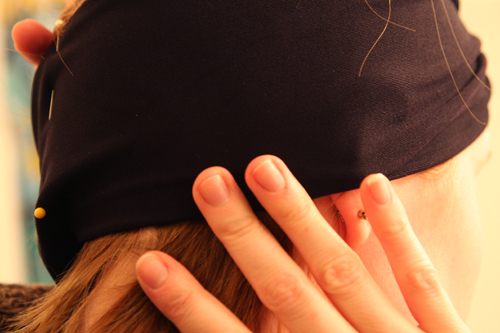
—>If you just want a plain twisted-front turban like the Olsen twins below…you’re done!  If you want to spike it and stud it like Jennifer Behr’s piece, keep reading…Tutorial continued…

6. Try on head-wrap; bunch it up in a couple places and pin.7. Hand-tack the bunched-up areas so the piece has a “gathered” look to it.8. Now we stud! I slipped the turban over my leg and sat it on my knee for stability. I pushed the prongs of the cone studs into the fabric, and folded them over on the underside of the fabric using pliers.9. Then use an awl to pierce the holes for the cone spikes, which have a thick screw that needs to pass through the fabric. (The easiest way to do this is to poke the hole thru from the right side – then thread the spike screw in from the wrong side, following the awl as you pull it out.) Then attach the cone spike tops, and use a screwdriver to secure from the underside. (not pictured)
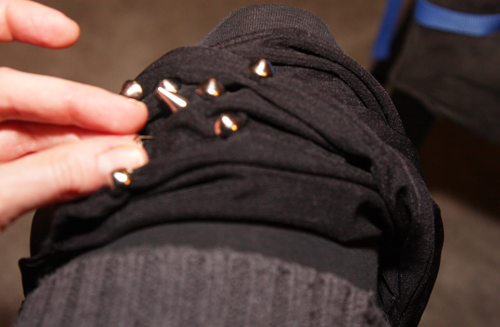
As you can see above, it turned out kind of like a wide headband!

You’re done! I didn’t add quite as many spikes ‘n’ studs as the Jennifer Behr version – simply because I got tired of it. I actually made a second layer to the piece so the center twist wouldn’t be so narrow and I could stud and spike through the upper layer only. This ensured no scratchy stud prongs would be directly against my forehead, but it turned out that the inner layer was a no-go since the spikes wouldn’t sit properly when there was fabric sitting underneath them. If you do choose to add another piece of fabric inside the headwrap (making it shorter than the headwrap and stitching its edges to the headwrap edges so it’s like a little stitched-down flap inside); I’d recommend studding the cone studs in the upper layer of fabric, but setting the spikes through both layers so they sit right. I know that sounds confusing!

The fabric’s stretch is a bit of a problem – some spikes may fall out if you pull the piece too much, so this requires care when handling.  FRA-GEE-LEH as they say in Italian!  (Okay, I guess I’ve seen A Christmas Story way too many times…;-)

What do we think? Does this work? Is this a no-go? Do I look like I am about to join a biker gang?

If you need further proof that studded headbands are all that this season, this Givenchy studded headband was featured in WhoWhatWear’s December holiday gift guide. Loving the chain gloves too!

But I’m a little wary of the studs-around-the-head look…they remind me of something quite Biblical.  Ah, who’m I kidding??  It’ll be my next DIY, guarantee ya.  (DIY available here.)

Happy DIY’ing!
xoxox
Carly

Save

Leave Comment

DIY: The Easiest Party Skirt To Make…Ever

Okay, maybe not the easiest skirt in the history of the world…but pretty darn simple nonetheless!

It took me about an hour and a half to make – tops! And it’s a simple, sweet party skirt that also works great for the everyday.

You Need:
*1 yd. of medium to heavy-weight satin, sateen, satin peau, or taffeta
*7/8″ width woven no-roll elastic (length of elastic = your waist circumference – 1″)
*matching thread

*scissors
*pins
*measuring tape
*iron & ironing board
*sewing machine
*sewing needle for wovens
*1 safety pin/bodkin
*overlocker/serger (optional)

How To: (sorry no step-by-step photos)

(I think this size will work on Small-Medium-Large…for a Small, the skirt will be fuller and more cinched in at the waist. If you want more width to the skirt, increase the width of the panels. My waist is 27″; hips are 34.5″. Cutting directions, marker, and yield are using a 60″ wide piece of fabric.)

CUT PIECES
1. Cut two rectangles on-grain for the front and back pieces: both are 21.75″ long; the front piece is 14 3/16″ (that’s fourteen and three-sixteenths, if the way I’ve typed it is confusing). For the width of the back piece rectangle, add 1/2″ (therefore width of back piece = 14 and 11/16″).

2. Cut 2 rectangular side panels on-grain: both 21.75″ long and 11.125″ (eleven and 1/8″) wide.

3. Cut 2 pockets: both are the same width as the side panels (11 and 1/8″) and are 9″ high. (The front, back, and side panels you can all fit side-by-side on a 60″ wide piece of fabric, but the pockets can’t fit and will have to be placed above this row when cutting. So technically, when using a 60″ wide piece of fabric, you only need 30.75″, not really a whole yard. For a 45″ wide piece of fabric, you can only fit the front, back, and one side panel side-by-side; the next row up you could place the other side-panel on-grain and thereby require 43.5″ of fabric (about 1 yd. and a quarter), or, alternatively, you could place one side panel on the crossgrain and only use 11 1/8″ + 21.75″ = just about a yard total. This is what I did because I thought I had bought a piece of 60″ wide fabric but it turned out to be only 45″ wide – so I had to conserve fabric. In satin, I honestly think on-grain vs. crossgrain difference is negligible.)

4. Overlock/zigzag stitch on top and bottom edges of pockets.

FINISH TOPS OF POCKETS
5. Fold 1″ under on tops of pockets. Iron to set the crease. Stitch seam at 3/4″ down from top of crease.

SEW POCKETS TO SIDE PANELS
6. Start by placing pocket on top of side panel, right sides together. Align top of pocket about 4″ above bottom of side panel, and align pocket side edges to side panel side edges. Stitch 3/8″ below top of pocket, through both layers, from side to side.

7. Fold pocket up, taught against the seam you just sewed; iron to set the crease. Pin side edges of pocket to side edges of side panels – then staystitch the pocket to the side panels a scant 1/4″ from side edges.

ASSEMBLE THE SKIRT
8. Overlock or sew each side panel to either side of the front piece; join back piece in the same way.

HEM THE SKIRT
9. Overlock/zigzag bottom edge of skirt all the way around.

10. Turn up 3.25″ from bottom of skirt; iron to set the crease. Stitch hem at 3″ up from crease.

ADD THE WAISTBAND
11. Overlock/zigzig top edge of skirt all the way around.

12. Turn under top of skirt 1.25″ from top edge. Iron to set the crease. Stitch at 1″ from crease – leaving 2″ unsewn, to create the waistband casing.

13. Attach safety pin or bodkin onto end of elastic. Thread elastic through the waistband casing, entering and exiting through the unsewn area.

14. Overlap ends of elastic by 1/2″. Pull elastic ends out of the unsewn gap in the casing, and stitch a square shape on the top of the elastic to secure.

15. Tuck elastic back into casing area – then sew the last 2″ of the casing closed.

You’re done!

This skirt is super-cute and can be worn in a casual ensemble.
Or you can dress it up and pair it into a party outfit – layer over a corset, for instance, or under a sequined vest.

People will feel a strange attraction to it when you wear it.

Everyone will love it unconditionally!

Happy DIY’ing…and Happy New Year!

xo
Carly

Leave Comment

DIY: Lace Top to Lace Vest

I’ve stuffed the stockings, laid out piles of prezzies under the Christmas Tree, emailed 18 of my closest friends holiday greetings, realized I’ve forgotten to stock my fridge with eggnog – and now I’m DIY’ing.
Isn’t that what Christmas is all about???:-)

The lacy ruffled vest: I know, it’s a strange concept. But I’ve been seeing these since summer in Tokyo – on all the coolest girls, and plastered all over the Japanese mags – where girls are using it as a feminine layering peice to tone down the masculinity of all that black, denim, and studs.

And it’s super-easy to make!

You Need:
*lacy long-sleeved top (I found mine at Goodwill – but you can probably find one at any thrift store – or even off-the-rack, since 80’s lacy stuff is experiencing a huge revival right now)

*fabric scissors
*sewing machine
*matching thread
*needle for finer woven fabrics

How To:

step11. Cut the sleeves off your top carefully so you leave the finished armhole seams on the shirt. Cut straight down the center of the shirt. (If your shirt didn’t have a V-neck before, cut the neck into a V-shape.)

2. Cut each sleeve in half vertically and spread open.

3. Place one sleeve on one side of the cut front of the top. (Orient the top of the sleeve cap at the end of the V- of the V-neck; and the sleeve itself centered on the cut CF edge. The sleeve bottom/cuff area will likely be slightly longer than your top length.) Stitch the sleeve to the top along your shirt’s cut edge. (not pictured)

4. Repeat for the other sleeve – attaching to the other side of the top’s center front vertical cut edge.

step55. Cut the sleeve edges into a scalloped pattern – you can follow the pattern of your lace – or cut in a vertical zigzag – or scalloped – it’s up to you. It may take a couple tries of cutting and then trying the piece on to see how the fabric falls – and adjusting after that.

done2You’re done!

Wear under a denim vest (my DIY here), layer under a fur vest, throw on over a slim-fit turtleneck – pair under a leather jacket or a men’s plaid top for the ultimate Victor/Victoria.

And if you don’t want to DIY – just buy – this adorable piece for $30 from jadelouse1’s Etsy store. (above)

Happy DIY’ing if you so choose – and Merry Christmas – Happy Hanukkah – and Superb (?) Kwanzaa!

xoxox
Carly

Leave Comment

DIY: 2 Men’s Shirts to Cute Babydoll Dress

Get This Tutorial As a PDF

7 DIY Men's Shirt Makeovers ebook

This tutorial has been updated, and is now available as a full step-by-step with photos in my new book 7 DIY Men’s Shirt Makeovers, part of the DIY Men’s Shirt Makeovers System.

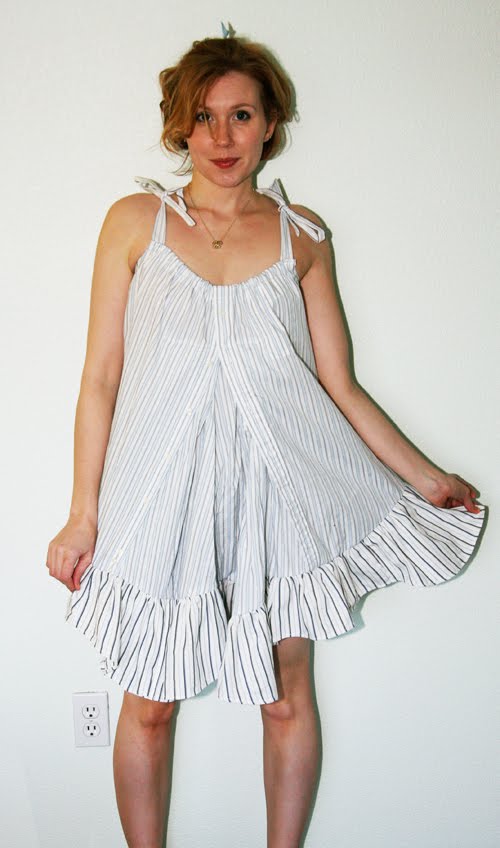
To take a break from my usual uniform of dark skinny jeans, black blazer, dark vest, and dark tee…I’ve created this adorable ruffled hem pleat-front ribbon-tie striped babydoll dress from 2 men’s button-down shirts.

(Sorry for the super-dark photos – my sewing room is lit only by a firefly, various glow-in-the-dark toys, and a sputtering birthday candle.)

You Will Need:

2 men’s button-down shirts in coordinating colors (I used size 16 – I think that’s an L, but I recommend using an XL if you are a S/M Misses’…an XXL if you are L/XL Misses.’)  /  thread matching topstitching thread in shirts  /  23″ of 3/4″ wide flat elastic (white)  /  3 m elastic cord (white)…we’ll be gathering fabric so only about 1m will be used eventually, but you need a longer length to do the gathering properly.

Tools:

sewing machine  /  needle for wovens  /  fabric scissors  /  seam ripper  /  iron (optional)  /  1 safety pin

How To:
PREP YOUR PARTS

1. Cut Shirt #1: the sleeves off the shirt and straight across the top just under the second button.
This will serve as the body for your dress.


MAKE THE FRONT INSERT & DRESS BODY

2. To make the front insert, first cut the cuffs off both sleeves and discard. Pin the sleeves together on the long side closest to the sleeve opening placket. Sew together with a 3/8″ seam allowance, open up the piece you just sewed, and lay flat.

3. Turn insert upside-down and pin both sides of it to the underside of the opened shirt front we cut in Step 1), matching bottom hemline. (Underlap about 3/8 – 1/2″ on button placket.)

Sew to shirt front vertically along button plackets.

4. Close top button. On underside, create pleats in front insert, and pin to underside of front.

5. Sew a line straight across the top of the insert, through all layers, catching all the pleats. (This will result in a visible line of stitching through the front of your dress.) Then sew button placket closed above the line you just sewed, going through all layers.

MAKE THE BOTTOM RUFFLE

6. Button up Shirt #2 and lay flat. Mark 7.5″ up from the bottom, and 7.5″ above that. Cut shirt straight across, through both layers, at both marks.

7. Using the bottom of the shirt as a guide, hem the upper strip in a similar fashion (note the center front and center back of the shirt is lower than both sides). I just traced the shape of the bottom hem, added 3/8″, turned under, and stitched a 1/4″ hemline. (I know, technically the top strip needs to be 7 and 7/8″ tall, not 7.5″…but we won’t tell anyone.;-) It’s easier to explain this way.)

8. Cut Shirt #2 according to the photo above: cut the sleeves off, and cut the yoke off the back (we’ll use the yoke later on).

As to the sleeves, mark 7.5″ down from the top of each sleeve, and 7.5″ down below that. Cut sleeves straight across at those marks. (We won’t be using the cuff pieces.)

Pin each sleeve piece together at sides to make one long continuous piece. (In this order: Sleeve cap + bottom piece + sleeve cap + bottom piece. If you’re totally anal about this piece matching the hemmed pieces from Step 7), cut one of the bottom pieces in half widthwise – and pin each half to the outside edges of this joined piece. I.e., bottom piece half + sleeve cap + bottom piece + sleeve cap + bottom piece half.)

Sew sleeve pieces together. Hem the edge that has the rounded part of the sleeve caps in a similar fashion to the piece you hemmed in Step 7), cutting off the extra to create a similar hemline.

9. Connect all 3 ruffle pieces together by sewing them at their sides with a 3/8″ seam allowance. (Connect all so you’ve made a continuous piece.)

10. Make a double knot in the end of your elastic cord. Place it on the wrong side, along the top of the ruffle piece you just sewed (about 3/8″ from the edge). Using a loose zigzag stitch on your sewing machine, zigzag over the elastic cord all the way around the ruffle piece. Do not stitch through the cord – it must remain free and moveable under your stitches. Backstitch a couple times at the beginning and end of your stitching to strengthen it.

11. Pull on the un-knotted end of the cord, gathering the fabric underneath it. Gather the ruffle piece until it is basically the same circumference as the bottom of your dress.

12. Pin the gathered ruffle to the bottom of the dress, right sides together. The bottom of the dress is already a curvy hem – pin the straight side of your ruffle around these curves. This will create a beautiful wavy hem when finished. Double-knot the elastic cording again once you have verified the pinned length of the ruffle – then cut off the extra cord.

13. Stitch ruffle to bottom of dress, stitching below the elastic cording.


GATHER THE DRESS TOP

14. Fold under top of dress about 1″+. Stitch straight across bottom of folded edge to create a casing.

15. Attach safety pin to one end of your flat elastic. Thread through the casing and out the other side.

16. Match end of elastic to edge of dress; stitch down the edge to secure.

17. Hold the elastic firmly and gather the front fabric – the finished width of your dress front needs to be 11.5″.

18. Once at the correct width, stitch down the other end of the elastic, and trim so nothing is visible from the front.

19. Repeat for the back of the dress – the finished length for the back of the dress needs to be 10.5.” 

MAKE THE SHOULDER-STRAPS

20. Cut back yoke off Shirt #1 as well as from Shirt #2…which we did in Step 8). (The yoke is usually double-sided; if yours isn’t, you have to scavenge fabric from somewhere else on your shirt. I think the ties look best when the stripe pattern is going up and down the length of the tie, not across, so I chose an area where I can get a piece of fabric 17.5″ long with the stripes going up and down.)

21. Sketch out the following shape onto both pieces: a tall trapezoid, with the top side 1.25″ wide, the bottom 2.5″ wide, and the entire piece 17.5″ tall. Cut shape out, separate the front and the back, and remove any labels with a seam ripper.

22. Fold each piece over, right sides together, and sew along longest edge, pivot, and along shortest edge. Turn piece right side out, and topstitch along unstitched edge to flatten it. (You can also iron it at this point to flatten it out further.)

23. Pin each piece under the top of the dress, at both front and back, about 1/2″ down from top hem, on either side. I positioned the pieces matching the dress body at the front, and the pieces matching the ruffle at the back.

24. Stitch across strap through all layers using a zigzag stitch for strength.

25. Tie bows tightly to prevent slippage.

You’re done!

You now have a super-cute dress perfect for lounging about, a sweet babydoll nightie appropriate for the boudoir – or even, under a blazer and over jeans or leggings, a chic piece to add into any day ensemble. Or you can wear it out as is during warmer months – rocking it with some lace-up sandals, a little metallic clutch, and a rhinestone clip in your hair.

(Daiso 100yen shop multi-ring necklace, vintage blazer, handmade dress, DKNY jeans, Payless Victorian button booties)

Notes: 

When I created the front of the dress, I sewed 2 sleeves together – resulting in a wide pleat at the front which can, in profile, make the wearer look preggers.:-P If you prefer a less generous A-line, create use a single sleeve instead for the front insert. This dress, because of the generous front pleat, would also be great maternity wear! (It’s kind of cute-sexy, so I think it would work great!)

I would recommend if you wanted fuller bows – to either use fabric from other parts of the shirt and double the width of the cut parts…or cut the pieces as I wrote above and instead of folding them in half, just fold under the raw edges about 1/4″ and topstitch to keep in place (eliminating Step 22)- thus leaving you with single-layer fabric bows instead of double layer.

The finished dress may be somewhat short for some people -I’ve thus recommended an XL men’s shirt to hopefully deal with the length problem. Making the ruffle 8″ or 8.5″ high before you cut it out may also help with this if you’re concerned about the length – I am 5’6″.

I’d also recommend ironing your shirts first! My blue-striped shirt was a little rumply – which is reflected in the finished piece. The dress is now extremely difficult to iron due to all the ruffles – so make sure your shirts are free of wrinkles first!


Happy DIY’ing!
xo
Carly

Get This Tutorial As a PDF

7 DIY Men's Shirt Makeovers ebook

This tutorial has been updated, and is now available as a full step-by-step with photos in my new book 7 DIY Men’s Shirt Makeovers, part of the DIY Men’s Shirt Makeovers System.

Leave Comment

Don’t Buy, DIY: Christian Louboutin for Rodarte Super-Spiked Heels


This was a lo-o–ooooong time in coming. Hope you guys didn’t get bored waiting!:-)

The highly, highly coveted Christian Louboutin for Rodarte spike heels – only sold for a short time at Christian Louboutin boutiques in Fall of ’08, never showing up at Net-a-Porter, not ever appearing on eBay. Victoria Beckham even stepped out in the gorgeous gold ones below. But how to get a pair for oneself?

Source: StyleFrizz.com

The RedSole version.

Of course, you could always fork over $188 for the black knockoffs over at RedSole (or here for the gold ones, pictured above). They’ve changed that texturized (Swarovski-encrusted?) area on the toe to snakeskin, and the heel isn’t as high or as skinny, but it’s a fairly good knockoff…if you want to pay $188.

(source: Fashion Mongers)
You could always DIY your own following the instructions at Fashion Mongers here for a similar style also in the Rodarte line.
But I wanted the exact same style as the shoes above on the right, butin black- and I haven’t found any DIY tutes out there on the Internet yet (correct me if I’m wrong!:-) So here ya go – step by step!

I have to break the process into multiple steps, since this is quite long though not excessively complicated. So, in 4 Parts:

To DIY Your Own Pair of Rodarte Spiked Heels You Will Need: (after the jump)

(more…)

Leave Comment

Pin It on Pinterest