DIY: 3 Men’s Shirts to Convertible Skirt

Get This Tutorial As a PDF
7 DIY Men's Shirt Makeovers ebook

This tutorial has been updated, and is now available as a full step-by-step with photos in my new book 7 DIY Men’s Shirt Makeovers, part of the DIY Men’s Shirt Makeovers System.

Well, it’s high time I shared another men’s shirt refashion, no?:-)  Spring is in the air and I’m looking at lighter layers and breezy fabrics.

I last wore this piece on Day 15 in my 30 Days of Outfits Challenge back in November of 2010.

This particular project uses 3 men’s button-down shirts…which may seem like a huge waste, but if you do have a bunch of old shirts laying around, or have shirts where the arms/collars are damaged and no one can wear them anymore, or if you are buying items at 80 cents a pound from the Goodwill Outlet…then it may seem like a useful repurposing.  (I used the back of a shirt I had leftover from a previous DIY, and one shirt we were getting rid of since the cuffs were frayed, and one I bought from Goodwill.)  And you can obviously use black shirts or differently-patterned shirts so you can create a piece that’s more your own style or works better in your closet than a blue pinstriped piece (which is what I chose to make).

In any case, these shirts can be made into a cute little puff-bottom skirt, whose buttons can be unbuttoned so you can wear it as a puff tube top, OR a midi-length long skirt, OR even a tube-top dress for when the weather gets warmer.  Here’s how to do it:

Project Difficulty:  (intermediate)

You Need:

3 men’s button-down woven shirts (only 2 are pictured above…since I first tried to create this skirt using only 2 shirts – which I found impossible.  My shirts are size XL.)  /  1/2″-wide knitted waistband elastic (don’t get the roll-resistant type; I did and found it “catches” on the lightweight shirt fabric too much when threading it through the casing, making what should be a very simple process extremely difficult)

Tools:

scissors  /  tape measure  /  marking chalk  /  pins  /  safety pin  /  matching thread  /  sewing machine  /  needle for light- medium-weight wovens  /  iron & ironing board  /  about 2 yd. elastic cord (not pictured; you’ll be removing it from the final piece anyway)

How To:

Make the Top Piece

1. Open two of your shirts and lay them with the right-hand sides flat.  Measure a piece 9″ wide (including the button placket) by as high as you can get to make a rectangle shape on each right-hand side.

2. Cut out each rectangular piece.  Also cut straight across the bottom edges to perfect the rectangle – which I haven’t shown above.

3. Sew the short ends of the button-side of the 2 front pieces together to make a circle.  This will be the Top Piece of your skirt.

Make the Main Piece

4. Fold the back of one of your shirts in half (vertically), and measure 9″ from the fold, in a straight line at the bottom of the shirt.  Mark that line.

5. Draw straight upwards from the end of the line, as far as you can to the top of the back part, then draw another horizontal line heading back to the center fold.  Cut – and you now have a large rectangle 18″ wide and as long as you can salvage from the back of the shirt.

6. Repeat this for the back pieces from your remaining 2 shirts.  You should now have 3 large rectangles – all 18″ wide and as long as you could get from the shirts.  If your fabric is super-wrinkly, now would be a good time to iron all those pieces flat.

7. Sew the 3 rectangular shirt-back pieces together along their long ends using a French seam.

Not sure what a French seam is?  To put it simply, you place the fabric pieces wrong-sides-together and sew the seam.  (So the seam allowances are on the outside of your project.)  Then you flatten the seam allowances to the left, and then fold the allowances + fabric underneath them to the right, and topstitch the seam to conceal the raw edges.  (You can see the fold at the top of the photo above, and my raw edges which I’m concealing as I go at the bottom.)  By creating French seams, this allows the skirt bottom piece to be finished completely on the wrong side as well – so it will look perfect when you flip it to the outside for the puffy bottom to the skirt.  You can get the illustrated how-to instructions for sewing a French seam here.

Attach the Skirt Pieces Together

8. To size the skirt Main Piece to fit with the Top Piece (which isn’t quite as wide), zigzag-stitch over a piece of elastic cording (with one end knotted) – onto the underside top edge of the skirt Main Piece.  Keep the stitches loose and make sure they go over the cord and don’t catch any part of the cord in the needle.

9. Pull the cord to gather the fabric of the skirt Main Piece.  Pull the cord until the circumference of this piece is about the same as the circumference of the skirt Top Piece.

10. Pin the skirt Top Piece over the Main Piece – overlapping enough so you can stitch above the buttons and catch the skirt Main Piece beneath. Stitch, following the seam of the button placket (but not through the elastic cord at all).  Remove the elastic cord by pulling backwards on the knotted end.

Create the Hem of the Skirt

11. Cut off the left-hand buttonhole placket from 2 of your shirts.

12. So you now have 2 buttonhole plackets.  Take the two buttonhole plackets you cut off…

13. And sew them together, end to end, to make a circle, using French seams.

14. Re-use the piece of elastic cord you used in Step 8), and zigzag-stitch over it at the bottom raw edge of the skirt.  Pull on it to gather the bottom hem of the skirt so it is the same size as the buttonhole placket circle piece.

15. Pin the bottom raw edge over the buttonhole placket circle piece.  (Don’t worry about lining up the buttonholes to the buttons at the junction of the Top Piece and Main Piece of the skirt…they won’t line up perfectly, and that creates a bit of a “puffy” shape to this skirt anyway.)

16. Topstich the buttonhole placket on top of the raw edge hem of the skirt (do not stitch through the elastic cord).  Again, I followed the line of topstitching of the placket that already existed.

17. Remove the elastic cord by pulling on the knotted end and slipping it out from under the zigzag stitches.

Create the Skirt Waistband

18. To make skirt casing for the waistband elastic, fold the top part of the skirt under about 1/4″, and then under again about 5/8.” Stitch to create casing. (If holding down the double fold is too tricky, you can always fold down 1/4″ and stitch, and then fold down 5/8″ to be really precise and neat.) Leave about 1″ unsewn so the elastic can be added.

19. Measure your elastic by place it at your waist, and cutting it where the ends meet.  (You’ll be overlapping the ends about 1/2″ when sewing, which will create enough tension to keep the waistband in place once finished.)  Attach a safety pin to the end of your elastic piece, and thread through the casing from the 1″ opening you left in the previous step.

20. Overlap the ends of your elastic by 1/2″, and stitch over them, making a rectangle with an X through the center for strength.

21. Slip the elastic ends inside the casing, and topstitch the 1″ gap to close.

And You’re Done!

Though technically I think it’s really meant to be a little puff-bottom A-line skirt, with the buttonhole placket on the hem folded up and buttoned onto the buttons on the top piece of the skirt…

You could also wear it as a tube top dress with the waistband pulled over your chest, and the buttons undone.  The Top Piece creates a nice little “shelf” at the bodice – which looks sweet and summery when belted…

And you could also wear it as a longer midi-length skirt (with the buttons unbuttoned), though I found it’s a kinda difficult length to pull off…
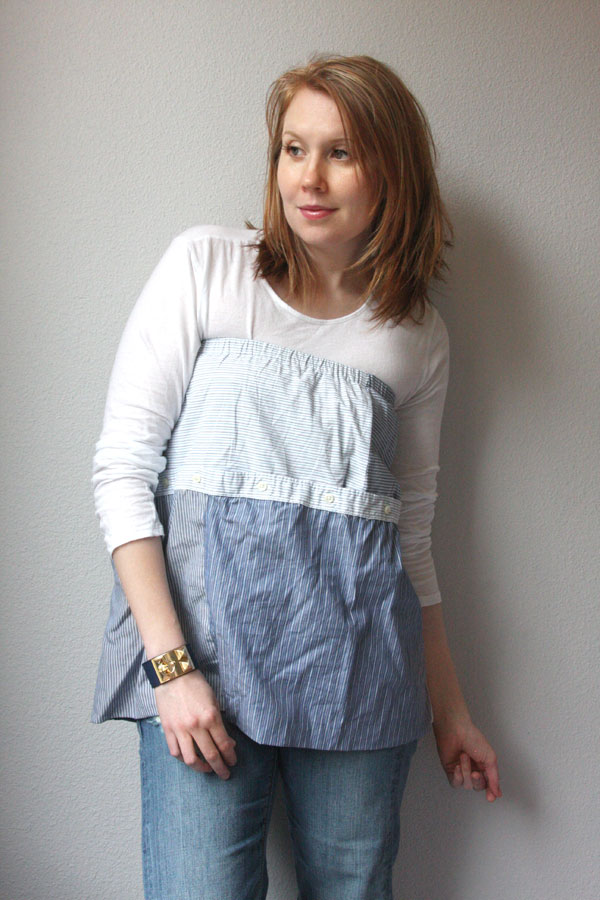
And when I tried to style it as a tube top (with the buttons buttoned and the waistband worn over my chest), I realized I looked like I was in maternity wear. (*’0’*)

In retrospect I should have ironed this piece again before I took more pictures – it had been squashed in my closet awhile.;-)

In any event, I know I’ll be able to find a lot of use for it as a skirt – especially when I want to add some pattern to an outfit that is in desperate need of breaking up the solid blocks of color I always default to.;-)

Happy DIY’ing!
xo
Carly

Get This Tutorial As a PDF

7 DIY Men's Shirt Makeovers ebook

This tutorial has been updated, and is now available as a full step-by-step with photos in my new book 7 DIY Men’s Shirt Makeovers, part of the DIY Men’s Shirt Makeovers System.
Leave Comment

DIY: Pillowcase to Elastic-Band Skirt Makeover

Pillowcases come in a variety of prints that work just as well for pieces clothing.  Plus, they have just enough fabric (and are roughly the same shape) as a cute little A-line mini-skirt – and can be transformed easily, with just a couple seams.  (You can of course also transform them into dresses and skirts for small children.)  And now there’s no need to worry when you have a lone pillowcase and can’t find its mate.

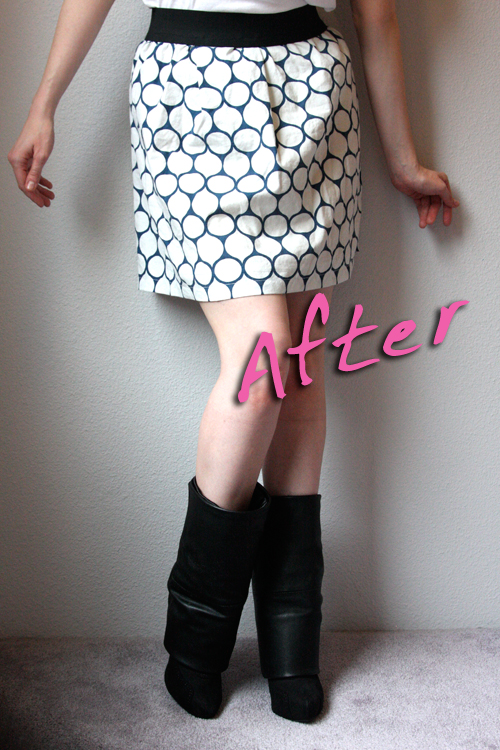
Take Exhibit A, a dot-printed piece that I pulled out of my 48-lb. haul of clothing I sourced at my local Goodwill Outlet.  I was drawn to it because of the fabulous print – and I could only find one of them, so I had no intention of using it as a pillowcase…thus I thought it would work great as a skirt!  The whole process took me maybe 30 minutes – a quick-sew project to be sure!

How to Make an Elastic-Banded Mini-Skirt from a Pillowcase

You Need:
*a standard-size (or larger!) pillowcase
*2″ wide piece of black elastic
*tape measure
*marking chalk
*pins
*fabric scissors
*thread and machine needle for wovens
*iron & ironing board

How To:
1. Turn pillowcase inside out and cut off all the sewn seams, leaving two large rectangles.

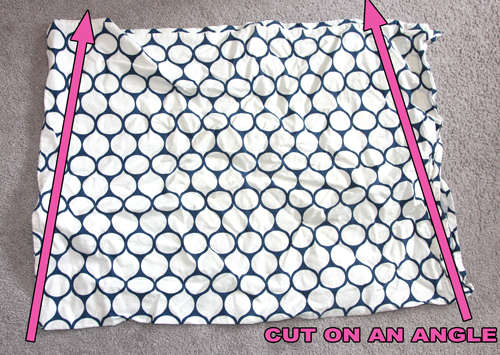
2. Turn rectangles sideways and fold in half.  Cut edge on a slight A-line angle to the top.  (I know in the photo above the fabric isn’t folded in half – but you should probably do that to ensure the right and left sides of each piece are at exactly the same angle.)

3. Unfold your pieces.  Measure 1/2″ in from the angled edges of one of the pieces, and cut.  This piece will become the back of the skirt.

4. Pin back to front of the skirt at the angled sides, and sew together.

5. Wrap piece of elastic at your natural waist (or where you want to wear the skirt).  Make sure it is taut on your waist – not so tight you can’t breathe – but fairly tight.  Overlap ends by 1/2″ and cut.

6. Sew piece of elastic in a circle on your machine with a 1/2″ seam allowance.  (I used a straight stitch, then flattened each end and zigzagged over it to further secure it.)

7. Place elastic band over pillowcase top, overlapping about 1/2″.  Match pillowcase skirt center front  to center of elastic band, and skirt center back to the seam you sewed in Step 6).  Pin the two sides as well.
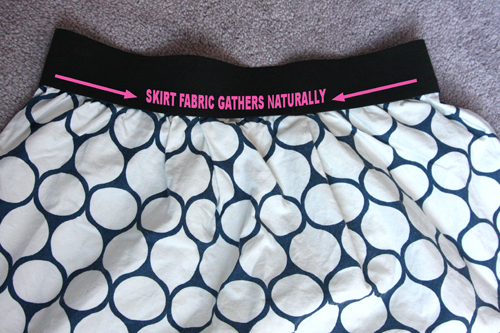
8. Sew pillowcase to elastic band using a stretch stitch on your machine, with the elastic on the top and the fabric below being thread through by the machine’s feed dogs.  Stretch the elastic between the pins so the pillowcase “gathers” naturally to the elastic.

9. Try on the skirt, mark where you want your hem to fall, and turn the hem (about 1″).  Sew a 3/4″ hem on the bottom.

10. Iron to set the hem and remove any creases.

And that’s it!  And the great thing is, the waist is elastic, so you can wear it belted higher up with a wide belt…or wear it lower near your hips for a different look.  Hope you have as much fun making yours as I did mine!

full2Happy DIY’ing!
xoxo
Carly

~If you liked this post, please share it!~

Save

Leave Comment

Alexander Wang Ruffled Skirt…Found in Forever21???

(from zippermanufacturers.com)…Buy a metal-coil non-separating black zipper from a sewing supply store…

for a whole lot less.

I’m onto you, Forever21!  You thought if you waited a year and a half, no one would notice you’ve knocked off Alexander Wang’s skirt (shown above, from the Lucky Magazine August 2008 issue – taped into my “inspiration files”)

Well – haha!  The ruse is up.

I’ve now snapped up the Tiered Skirt from one of your stores, and will be adding a zipper and black waistband shortly – to make my very own Alexander Wang Ruffled Skirt lookalike!

$495 vs. $29.79 (the zipper is $4.99)….who is the wiser now, hmmmmm?

xoxox
Carly

Leave Comment

DIY: The Easiest Party Skirt To Make…Ever

Okay, maybe not the easiest skirt in the history of the world…but pretty darn simple nonetheless!

It took me about an hour and a half to make – tops! And it’s a simple, sweet party skirt that also works great for the everyday.

You Need:
*1 yd. of medium to heavy-weight satin, sateen, satin peau, or taffeta
*7/8″ width woven no-roll elastic (length of elastic = your waist circumference – 1″)
*matching thread

*scissors
*pins
*measuring tape
*iron & ironing board
*sewing machine
*sewing needle for wovens
*1 safety pin/bodkin
*overlocker/serger (optional)

How To: (sorry no step-by-step photos)

(I think this size will work on Small-Medium-Large…for a Small, the skirt will be fuller and more cinched in at the waist. If you want more width to the skirt, increase the width of the panels. My waist is 27″; hips are 34.5″. Cutting directions, marker, and yield are using a 60″ wide piece of fabric.)

CUT PIECES
1. Cut two rectangles on-grain for the front and back pieces: both are 21.75″ long; the front piece is 14 3/16″ (that’s fourteen and three-sixteenths, if the way I’ve typed it is confusing). For the width of the back piece rectangle, add 1/2″ (therefore width of back piece = 14 and 11/16″).

2. Cut 2 rectangular side panels on-grain: both 21.75″ long and 11.125″ (eleven and 1/8″) wide.

3. Cut 2 pockets: both are the same width as the side panels (11 and 1/8″) and are 9″ high. (The front, back, and side panels you can all fit side-by-side on a 60″ wide piece of fabric, but the pockets can’t fit and will have to be placed above this row when cutting. So technically, when using a 60″ wide piece of fabric, you only need 30.75″, not really a whole yard. For a 45″ wide piece of fabric, you can only fit the front, back, and one side panel side-by-side; the next row up you could place the other side-panel on-grain and thereby require 43.5″ of fabric (about 1 yd. and a quarter), or, alternatively, you could place one side panel on the crossgrain and only use 11 1/8″ + 21.75″ = just about a yard total. This is what I did because I thought I had bought a piece of 60″ wide fabric but it turned out to be only 45″ wide – so I had to conserve fabric. In satin, I honestly think on-grain vs. crossgrain difference is negligible.)

4. Overlock/zigzag stitch on top and bottom edges of pockets.

FINISH TOPS OF POCKETS
5. Fold 1″ under on tops of pockets. Iron to set the crease. Stitch seam at 3/4″ down from top of crease.

SEW POCKETS TO SIDE PANELS
6. Start by placing pocket on top of side panel, right sides together. Align top of pocket about 4″ above bottom of side panel, and align pocket side edges to side panel side edges. Stitch 3/8″ below top of pocket, through both layers, from side to side.

7. Fold pocket up, taught against the seam you just sewed; iron to set the crease. Pin side edges of pocket to side edges of side panels – then staystitch the pocket to the side panels a scant 1/4″ from side edges.

ASSEMBLE THE SKIRT
8. Overlock or sew each side panel to either side of the front piece; join back piece in the same way.

HEM THE SKIRT
9. Overlock/zigzag bottom edge of skirt all the way around.

10. Turn up 3.25″ from bottom of skirt; iron to set the crease. Stitch hem at 3″ up from crease.

ADD THE WAISTBAND
11. Overlock/zigzig top edge of skirt all the way around.

12. Turn under top of skirt 1.25″ from top edge. Iron to set the crease. Stitch at 1″ from crease – leaving 2″ unsewn, to create the waistband casing.

13. Attach safety pin or bodkin onto end of elastic. Thread elastic through the waistband casing, entering and exiting through the unsewn area.

14. Overlap ends of elastic by 1/2″. Pull elastic ends out of the unsewn gap in the casing, and stitch a square shape on the top of the elastic to secure.

15. Tuck elastic back into casing area – then sew the last 2″ of the casing closed.

You’re done!

This skirt is super-cute and can be worn in a casual ensemble.
Or you can dress it up and pair it into a party outfit – layer over a corset, for instance, or under a sequined vest.

People will feel a strange attraction to it when you wear it.

Everyone will love it unconditionally!

Happy DIY’ing…and Happy New Year!

xo
Carly

Leave Comment

Tie-Dye Denim Mini Using Tulip Fabric Dye…for $12.

Tie-dyed denim is ba-a-aaack this season (sure you probably thought you’d never see the day) but it’s a blotchy, abstract dye that’s all over the runways…and all over celebs and fashionistas in the know. (And what I got knocked for in Challenge #1 in America’s Most Stylish Blogger competition. Whatever! If you haven’t noticed this trend – insert your head back in its hole in the sand.) Whether you embrace it or stay far, far away – using the crumple dye technique on your fabric is fun and virtually hassle-free (compared to some other tie-dye techniques that involve rubber-banding, stirring fabric for 15 minutes continuously etc.).

This is an image from Victoria’s Secret most recent catalog…and you can buy the sweater here but the skirt strangely seems to be unavailable. And I want that skirt.

So I used Tulip Permanent Fabric Dye and a denim miniskirt I found at the thrift store to create an abstract, funky dye-pattern.

The first step was bleaching the skirt to remove the color. This was accomplished by soaking in a hot water & bleach solution (ratio like 8:1 or something like that)…for like 8 hours. Had I used full-strength bleach (or a smaller ratio of water to bleach), the process would have been much quicker, but it also would have caused rusting on the metal embellishments on the skirt (zipper, grommets etc.), weakened the fabric fibers and seams, and even perhaps burned holes in the fabric or given the piece an orange tint. So to be safe I diluted.

Most of the color was removed by this method. Ran it through the wash cycle (with detergent) to get rid of any remaining bleach.

Now it’s time for the dye!

Following the instructions, I created a dyebath of Black fabric dye…and dipped the skirt into it. I then pulled it out quickly, crumpled it on top of a spread-out garbage bag, and spooned dye from the bath onto certain areas of the skirt. Hmm…it didn’t work so well. By giving it that initial dip in the bath, I found that the skirt soaked up a base gray color that wouldn’t show any darker black areas like I had intended. Ohwell. Frustrated, I poured some bleach (undiluted this time) back on the skirt in certain areas. After a few minutes as I watched some areas of the skirt lighten to a muddy brown, I washed the whole thing in cold water, then threw it in the wash cycle of the washing machine (sans detergent this time). And this is what I got:
Definitely not what I was going for. I then wet the skirt, crumpled it up again on another garbage bag, and spooned black dye from the dyebath onto certain areas of the skirt, crumpling as I went. I left it for a short time, covered in garbage bag, then pulled it out and ran cold water through it. Back to the washing machine (no detergent) and into the dryer, and I got this…

It’s hard to see, but the skirt is more gray-and-white-tinted than before.
(Kenneth Cole new york sweater, DIY Old Navy denim mini-skirt, Sam Edelman Zoe boots, unknown puffball ring)

Somehow I never look quite the same as the Victoria’s Secret model does. Hmmm.
And EVERYONE needs a puffball ring. It’s just a Fact of Life.

The final product: the tie-dyed skirt. I definitely wanted it to be black & gray…but this stone blue/gray/little bit of brown thing is cool, too. You just never know when you’re dying denim and working with bleach!

In reality Tulip One-Step Fashion Dye would make more sense for this project, especially since you’re applying dye directly to the fabric. But I used what I had! Perhaps I’ll try another application to make it more black at some point in the future, but I’m kind of satisfied with what I have now.

Also, if you’d like some different fabric-dyeing projects to try out (just in the nick of time if you’re still stuck on ideas for a Halloween costume!) download the free Fun with Fabric Dye eBook from FaveCrafts.com…This eBook features 28 free fabric dye craft projects organized by 18 different dye techniques, with step-by-step photo instructions. Not only does the eBook include a great variety of stylish clothing craft projects for all ages, but it also features home decorating projects, accessories and holiday projects too.

Definitely try your hand at the DIY tie-dye denim mini…just don’t dip the whole thing in the dye after you’ve bleached it out…crumple and spoon, my friends!

Happy DIY’ing…and Happy Halloween!
xoxox
Carly

Save

Leave Comment

Pin It on Pinterest