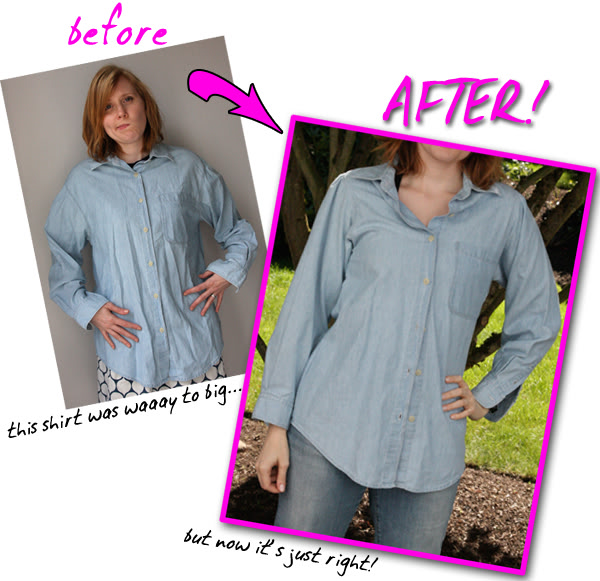
Tying in to my first Style It Chic! post from yesterday regarding the denim work shirt as current closet staple, in this post I’m going to show you how to fix that denim shirt you stole from your guy – or thrifted – into something that fits you properly.
As many of you know, I love finding both my materials and base items for my DIYs at the thrift store. I’m always searching out the biggest, baggiest shirts (so I have tons of material to work with!) for my shirt re-cons. Thus what I find is rarely pretty, and rarely fits. It’s always the potential for a remake that gets me so excited.
So what to do with those shirts that you find – that you want to wear yourself – but aren’t quite your size?? You’re going to be keeping the sleeves and the length, let’s say, but why doesn’t the shirt look like it fits right? And what to do?
Can you tell what it is that’s making my shirt look too big in the above photo?
This brings me to my first Fitting Tip, the most critical for making your shirt look like it’s the right size:
Fitting Tip #1: The make-it-or-break-it “does it fit?” criteria is where the ARMSCYE SEAM HITS THE SHOULDER SEAM.
I cannot stress this one enough. This is what makes the difference visually between “she’s wearing her boyfriend’s shirt” and “she’s wearing a cute shirt that fits her.”
We’ve all tried on a guy’s shirt before, right? And, invariably the seam connecting the sleeve to the shirt (called the “armscye seam”) will be hanging off our shoulders, lying somewhere on our upper arms.
This is a DEAD GIVEAWAY that your shirt doesn’t fit you!!
Even if the body is un-fitted, loose-fit, billowy tunic, whatever…if this seam is in the wrong place on your body then it will look like it is the WRONG SIZE FOR YOU!
When looking at yourself standing normally, this seam needs to be as close as possible to traveling straight up from your armpit to your shoulder, in a straight line. (Raglan or set-in sleeves are different, and there is a little variation to be had when you’re dealing with a blouson, caftan, or loose blouse or dress but in general this seam needs to be in that basic area.)
The closer this seam is to going straight up from your armpit – the more fitted and chic the garment will look. Even a t-shirt will look flattering and feminine if the sleeves are attached to the body at this line.
Fitting Tip #2: The body needs to connect close to your underarm for the garment to look “fitted.”
The body is far less important than this armscye seam in Fitting Tip #1. There are more variations when it comes to the shape and size of the body piece, so words like always or never aren’t very useful here. Again, in general if the body is too loose right at the underarms, the piece will look big and billowy on you, even if the armscye seams are in the right place.
So how to re-fit your shirt?
How to Re-Fit a Men’s Button-Down Shirt To Your Size
You Need:
seam ripper // marking chalk // pins // scissors // sewing machine & needle for the fabric in your shirt // thread matching the topstitching thread in your shirt // mirror
The Straight Pin Method: How to Move the Shoulder Seam of a Too-Big Shirt to Fit Your Body
1. Remove both sleeves by opening the armscye seams. Do not rip or cut through either the sleeves or the shirt body. Often button-down woven shirts have topstitched seams, so you’ll have to go through both rows of stitching to pull the arms off fully.
Remove all the little messy threads from your ripping.
2. Try the shirt on and button it up. Put one hand on your hip. Looking in the mirror, mark where your shoulder seam SHOULD be by drawing a straight line up from your armpit to your shoulder. Mark with a pin straight at the shoulder.
3. Take the shirt off and lay it flat. Sketch a line connecting the pin you marked the shoulder with and where the shirt hits at the armpit. (Make sure you “square” the line – which means that the line crosses at a 90-degree angle over the line of stitching connecting the back yoke. Add 3/8″ to the outside of this line. Draw the new armscye by mimicking the shape of the old one.
4. Cut off the excess fabric. Fold the shirt in half, sketch around the edge of the armscye you cut onto the other shoulder area, and cut off the excess fabric on the other side as well.
The Mirror Method: How to Re-Fit the Body of a Shirt That’s Too Loose
5. Try on the shirt again, buttoning it up and putting it on inside-out. Now the vest-like shape of it should look right – at least at the shoulder area. Pin at one side to make it more fitted, looking in the mirror as you go, placing the pins as close as you can to your body. Drop your arm and confirm in the mirror that the shape of that side is now fitted and looks “right” for your body – not too tight, not too loose, and the shirt can move with you without constricting.
6. Take off the shirt and mark at the pins. Copy your markings to the other side as well by folding the shirt at the center and pushing the pins through both sides, marking where they skewer the side without the pins. Unfold the shirt, lay it flat, and remove the marking pins. Draw a line of “best fit” to connect the marks your made.
8. Sew along the lines you drew and trim the excess. Now the shirt should fit your body properly. (I’m wearing a shirt underneath, so it looks like it’s very fitted in the photo above, but it’s actually loose when I wear it as a single layer.)
How to Set Shirt Sleeves That Are Too Big Into Smaller Armholes
9. Now that the shirt fits you in the body, it’s time to reattach the arms. Turn the shirt inside-out and place one sleeve inside it, right sides together. Pin the armcap of the sleeve to the armscye of the shirt, all the way around.
10. Sew the sleeves to the body. If necessary, topstitch both armscyes on the body side to re-create the finished look of the original shirt.
And you’re done! The manly shirt (or too-big women’s shirt!) should now fit you pretty well – and not look like you just stole from your guy’s wardrobe.
Note: With this method it’s unfortunate, but the sleeves will end up slightly shorter than those of the original shirt. It really can’t be helped, which is why I try to find my big shirts with too-long sleeves if I can.
In some cases, when you go to re-attach the arms you will find that there is too much excess fabric in the sleeve cap to fit into your smaller armscye. You have one of two options:
1) Make the sleeve smaller by sewing the sleeve seam closer together at the underside.
2) Match the sleeve seam to the shirt body side seam while pinning, and gather or ease the excess fabric at the sleeve cap to create a “puffed-sleeve” look.
When altering this particular shirt, I used Method #2 and ended up with sleeves that are slightly puffy at the shoulders.
This can be done with anything that has the sleeves set incorrectly for your frame: t-shirts, long-sleeved shirts, button-downs, dresses – anything!! Hope this expands your options when shopping at the thrift store and alerts you to fitting issues before you buy something that doesn’t fit you well!
Hope this expands your options when shopping at the thrift store and alerts you to fitting issues before you buy something that doesn’t fit you well!
Happy DIY’ing!
xo
Carly

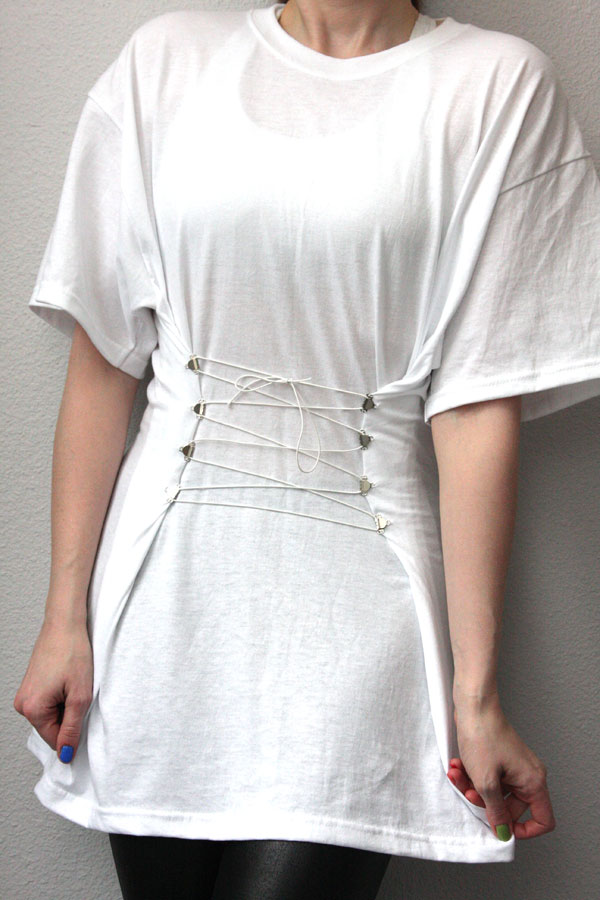 My hubby has a ton of white shirts that have seen better days…and sometimes I steal one or two of them to makeover for myself. But men’s shirts are so shapeless and boxy, and I want something that isn’t as boring as it looks straight out of the package! With a few strategically-placed hooks and some elastic cord, this is a quick DIY makeover that will turn any boxy and shapeless top into a form-fitting gathered tunic or dress. Minimalist sex-appeal at its best!
 *white tunic-length t-shirt (mine is XXL)
 1. Lay your t-shirt flat, back side up. Measure about 2.5″ down from below where the sleeves meet the sides. (This is what worked for me – you may want to try the shirt on you to make sure this is the area where you want the corseting to end.) Mark.
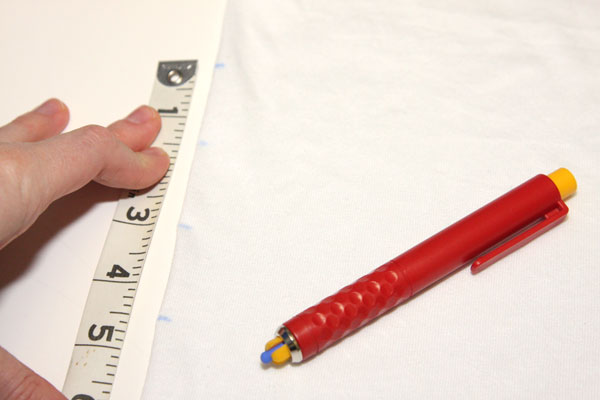 2. Measure below that mark 1.5″ and make another mark at each side. Repeat twice so you have 4 marks total, evenly-spaced at 1.5″ apart.
 3. Hand-sew the hooks on at each part. Since we’re sewing onto the back and the t-shirt fabric will be pulled to the front, make sure the hooks are facing outwards.
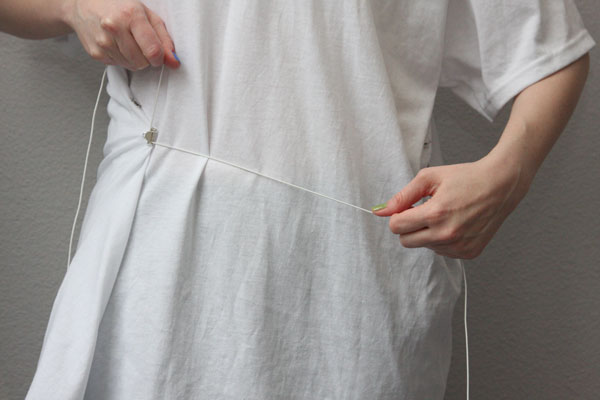 4. Try the shirt on. Take the elastic cord , fold it in half, and match its center to your bellybutton. Keep these lined up, thread either side of the cord into the bottom hook on either side of the shirt.
 5. Pull to the front, pulling the shirt fabric with it. Cross the cord over at your center, then back into the next hooks above.
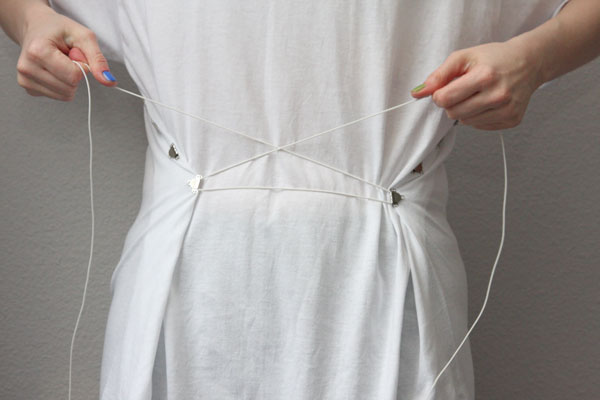 Continue to lace the corset-front in this manner, and rearrange the extra fabric of the tee as you go to look neater and more tucked-in to the corset area.
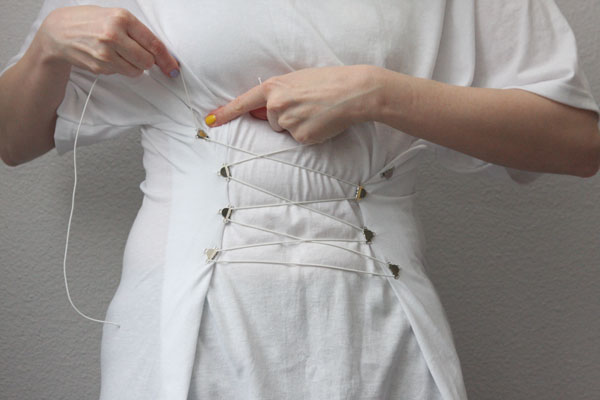
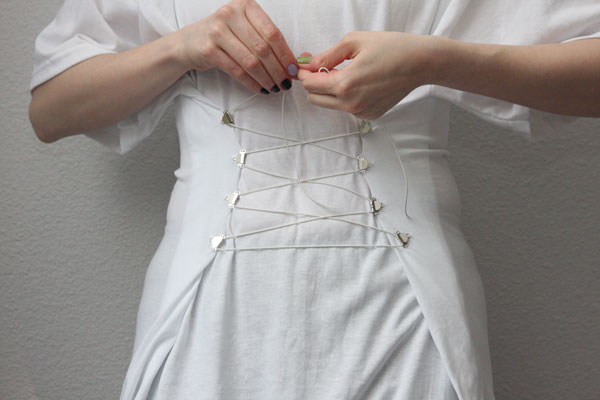 6. Tie the ends of the cords at the top of the corseting in a bow; trim the ends.
 (I’ll be re-posting all of them here on my blog soon.)


 (Easy/Beginner)





 (Medium)